
[one_full last=”yes” spacing=”yes” center_content=”no” hide_on_mobile=”no” background_color=”” background_image=”” background_repeat=”no-repeat” background_position=”left top” hover_type=”none” link=”” border_position=”all” border_size=”0px” border_color=”” border_style=”” padding=”” margin_top=”” margin_bottom=”” animation_type=”” animation_direction=”” animation_speed=”0.1″ animation_offset=”” class=”” id=””][imageframe lightbox=”no” lightbox_image=”” style_type=”none” hover_type=”none” bordercolor=”” bordersize=”0px” borderradius=”80″ stylecolor=”” align=”center” link=”” linktarget=”_blank” animation_type=”0″ animation_direction=”down” animation_speed=”0.1″ animation_offset=”” hide_on_mobile=”no” class=”” id=””]  [/imageframe][/one_full]
To understand the socio-cultural movements that inhabit the present and shape the future in a city like Lisbon. We want to understand these complex narratives to better grow.

[/three_fifth][two_fifth last=”yes” spacing=”yes” center_content=”no” hide_on_mobile=”no” background_color=”” background_image=”” background_repeat=”no-repeat” background_position=”left top” hover_type=”none” link=”” border_position=”all” border_size=”0px” border_color=”” border_style=”” padding=”” margin_top=”” margin_bottom=”” animation_type=”” animation_direction=”” animation_speed=”0.1″ animation_offset=”” class=”” id=””]
.
We study emerging mindsets.
We observe creative practices.
We map changes and ideas.
We navigate between the solid and the liquid.
We share our perspectives on the complex map of representations, speeches, experiences, practices and artifacts.
[/two_fifth][one_full last=”yes” spacing=”yes” center_content=”no” hide_on_mobile=”no” background_color=”” background_image=”” background_repeat=”no-repeat” background_position=”left top” hover_type=”none” link=”” border_position=”all” border_size=”0px” border_color=”” border_style=”” padding=”” margin_top=”” margin_bottom=”” animation_type=”” animation_direction=”” animation_speed=”0.1″ animation_offset=”” class=”” id=””][separator style_type=”none” top_margin=”” bottom_margin=”4%” sep_color=”” border_size=”” icon=”” icon_circle=”” icon_circle_color=”” width=”” alignment=”center” class=”” id=””]
[separator style_type=”none” top_margin=”” bottom_margin=”3%” sep_color=”” border_size=”” icon=”” icon_circle=”” icon_circle_color=”” width=”” alignment=”center” class=”” id=””][/one_full][one_full last=”yes” spacing=”yes” center_content=”no” hide_on_mobile=”no” background_color=”” background_image=”” background_repeat=”no-repeat” background_position=”left top” hover_type=”none” link=”” border_position=”all” border_size=”0px” border_color=”” border_style=”” padding=”” margin_top=”” margin_bottom=”” animation_type=”” animation_direction=”” animation_speed=”0.1″ animation_offset=”” class=”” id=””][/one_full][title size=”1″ content_align=”left” style_type=”default” sep_color=”” margin_top=”” margin_bottom=”” class=”” id=””]
The nature of the report: who? How? Why?
[/title][separator style_type=”none” top_margin=”” bottom_margin=”4%” sep_color=”” border_size=”” icon=”” icon_circle=”” icon_circle_color=”” width=”” alignment=”center” class=”” id=””][accordian divider_line=”” class=”” id=””][toggle title=”Context” open=”no”]
Who? Study carried out by the students of the MA in Culture and Communication, with the support of doctoral students in Culture Studies and professors from the Culture and Communication Program.
Where? Study organized and edited by the Trend and Culture Management Laboratory, a project of the Culture and Communication Program and CEAUL (University of Lisbon Centre for English Studies), School of Arts and Humanities, University of Lisbon.
When? The process of studying and the systematization of results took place between February and July 2020.
[/toggle][/accordian][separator style_type=”none” top_margin=”” bottom_margin=”1%” sep_color=”” border_size=”” icon=”” icon_circle=”” icon_circle_color=”” width=”” alignment=”center” class=”” id=””][accordian divider_line=”” class=”” id=””][toggle title=”Team and Credits” open=”no”]Copyright © 2020 Trends and Culture Management Laboratory, School of Arts and Humanities, University of Lisbon
Edited and Organized by Nelson Pinheiro Gomes
Tutors: Ana Marta Flores; Sarita Oliveira; Suzana Cohen; Suzana Leonardi; William Cantú.
Author Working Groups 2020:
Hypothesis 1 / (1/2020) / Topics – Identities, Experiences, Nostalgia: Heloisa Keiko, Gabriela Orestes, Gabriela Abreu, Cláudia Marques.
Hypothesis 2 / (2/2020) / Topics – Acceptance, Individualism, Polarity, Gender, Authenticity, Crisis: Gustavo da Silva, Jefferson Pereira, William dos Santos.
Hypothesis 3 / (3/2020) / Topics – Technology, Interaction, Personalization, Mobility, Innovation: Irina Martins, Filipa Pina, Nanqian Jiang.
Hypothesis 4 / (4/2020) / Topics – Sustainability: Marianna Rosalles, Francisco Mateus.
Hypothesis 5 / (5/2020) / Topics – Wellness, Privacy: Andreia Carneiro, Caroline Rocha, Karliete Nunes.
Focus Group and Trend Text Review: Nelson Pinheiro Gomes; Ana Marta Flores; Suzana Cohen; Suzana Leonardi; William Cantú; Clarissa Lopes; Sarita Oliveira; Illa Branco; Raquel Sodré.
Design and layout by William Cantú
Organization of
Trends and Culture Management Laboratory
Culture and Communication Program and University of Lisbon Centre for English Studies
SCHOOL OF ARTS AND HUMANITIES, UNIVERSITY OF LISBON
Digitally published on 11-07-2020, Lisbon.
http://creativecultures.
nelsonpinheiro@campus.ul.pt[/toggle][/accordian][separator style_type=”none” top_margin=”” bottom_margin=”1%” sep_color=”” border_size=”” icon=”” icon_circle=”” icon_circle_color=”” width=”” alignment=”center” class=”” id=””][accordian divider_line=”” class=”” id=””][toggle title=”Methodology” open=”no”]The Identification and Analysis of Sociocultural Trends
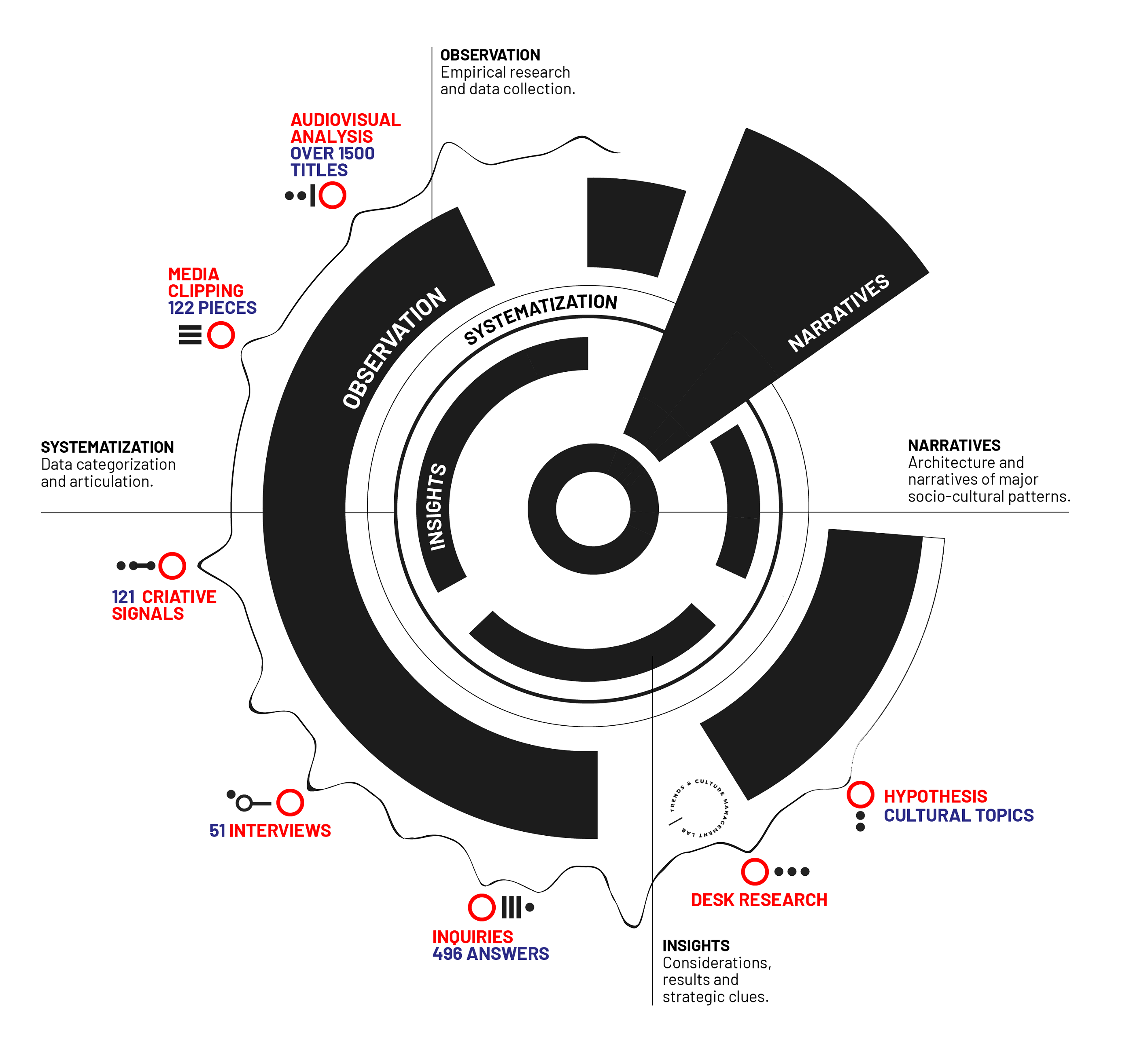
To structure this research, we followed the trend identification approach proposed by Nelson Pinheiro, Suzana Cohen and Ana Marta Flores (2018). It was developed based on the articulation of different authors´perspetives (we underline Dragt, 2018; Raymond, 2010; Vejlgaard, 2008; among others) and aims to inform a model of Trendspotting and Trendwatching, that is, the identification and analysis of trends. This exercise assumes three stages: (1) cultural observation and data collection (Gomes, Cohen and Flores, 2018, pp. 66-73) where the hypothesis is framed considering a cross review of analyzed sources; a qualitative research with audiences (as underlined by Raymond, 2010), covering interviews and surveys; and a set of coolhunts (see Rohde, 2011; Gloor and Cooper, 2007) – coolhunting assumes a prominent role here, as a practice inspired by ethnographic/netnographic practices that seeks creative signs that indicate the emergence of new practices and representations within the scope of changing mindsets. (2) The systematization of information (Gomes, Cohen and Flores, 2018, pp. 74-75) requires a thorough interpretation of the data and its analysis in a context of generating affinity links (see also Dragt, 2017; Mason et. al, 2015) to systematize the information and create groups of data that allow building a clear perspective on the architecture and nature of trends. (3) the last phase presupposes the design and architecture of the trend’s DNA (Gomes, Cohen and Flores, 2018, pp. 87-77) where, based on the systematized groups, we identify the nature of the socio-cultural trend and build its DNA and its descriptive text. These texts are then screened by a group of peers, specialists in Trend Studies and socio-cultural dynamics, through a Delphi process or a focus group, in order to revise the final text in the light of the research data.
Also known as secondary research, it seeks to identify works already carried out on the hypothesis and its topics, in contrast to the empirical and field work carried out from scratch for the research. We reviewed reports and other sources capable of bringing initial data.
Method 2 – Media Clipping
Based on the premise that the media underline important issues under discussion in the public square, each group collected news from the main national newspapers and other international sources related to the hypothesis. Group 1 brought together a total of twenty pieces, group 2 thirty-one, group 3 twenty, group 4 twenty and group five twenty-one, for a total of 112.
Method 3 – Coolhunting
The Coolhunting method was applied based on a convenience sample. Each working group identified twenty cool signals (with the exception of group 3 which identified twenty-one) that emerged both nationally and internationally, bringing together a total of one hundred and one signals. Of these, each group analyzed in depth those that they considered most representative of the hypothesis. Below we present eighteen signals, a sample of the signals analyzed in depth, representative of each hypothesis. In the analysis of the results, we considered the total universe of identified signals, with emphasis on the meanings and insights printed on the most representative.
Along with the Cool signals and considering the objective of underlining the Portuguese context, especially Lisbon, each group identified online, in a similar approach to the previous one, fifteen cool spaces and/or cool projects in the city of Lisbon with a clear relationship with each hypothesis. In total, students identified seventy-five spaces/projects related to the universe of hypotheses. In terms of limitations, the group approach did not allow verifying which trends had the greatest impact on urban spaces and projects.
Based on the premise that audiovisual production has the potential to translate changes in mindsets and the emergence of new narratives and symbolic constructions, it is important to understand the meanings contained in these products. To this end, each group collected information about (1) the films shown in Portugal in the last five years (1,860 titles reviewed) and (2) the productions available on the Netflix platform in Portugal. Each group analyzed the synopses and the contents of each object and underlined the appropriate associations with the hypotheses, in order to understand the weight and the expression of each trend in the total of analyzed productions.
Each working group developed a survey with inhabitants, workers or students in the city of Lisbon that took place online using social media communities. The surveys took place between the 20th of April and the 9th of May, with the exercise having obtained a total of 496 participations, within the scope of a random sample.
Each working group conducted semi-structured interviews, in terms of a convenience sample, with individuals from the general public, or with professionals/experts associated with the topics of the hypotheses. In total, between 15 April and 13 May, took place a total of 51 interviews. Of these, 12 with the general public and 39 with professionals or specialists in the themes.
After gathering the data that resulted from each method and drawing the initial conclusions, each group of students, with the support of tutors, systematized the information and results and grouped them by affinities into insights (strategic clues) on the nature of the trend under study. With this, they then structured the trend’s DNA and the preliminary text with its description. With this text and the main results of the research, researchers and young researchers of the Trends and Culture Management Lab reviewed the descriptions between May 25th and July 7th, 2020, through a process of several focus groups, which gave way to the final trend texts on 10 July 2020.
References:
DRAGT, Els (2017). How to Research Trends. Amsterdam: Bis Publishers.
GLADWELL, Malcolm (2006). The Tipping Point: How little things can make a big difference. New York: Little Brown.
GLOOR, Peter e Scott Cooper (2007). Coolhunting: Chasing down the next big thing. New York: Amacom.
GOMES, Nelson; Cohen, Suzana; Flores, Ana Marta (2018). “Estudos de Tendências: Contributo para uma abordagem de análise e gestão da cultura”. Moda Palavra, V.11, N.22.
HIGHAM, William (2009). The Next Big Thing. London: Kogan Page.
MASON, Henry; MATTIN, David; LUTHY, Maxwell; DUMITRESCU, Delia (2015). Trend Driven Innovation. New Jersey: Wiley.
PORTA, D.; KEATING, M. (2008). Approaches and Methodologies in the Social Sciences: A pluralist Perspective. Cambridge: Cambridge University Press.
RAYMOND, Martin (2010). The Trend Forecaster´s Handbook. London: Laurence King.
ROHDE, Carl (2011). “Serious Trendwatching”. Tilburg: Fontys University of Applied Sciences and Science of the Time.
VEJLGAARD, Henrik (2008). Anatomy of a Trend. New York: McGraw-Hill.[/toggle][/accordian][separator style_type=”none” top_margin=”” bottom_margin=”7%” sep_color=”” border_size=”” icon=”” icon_circle=”” icon_circle_color=”” width=”” alignment=”center” class=”” id=””][title size=”1″ content_align=”left” style_type=”default” sep_color=”” margin_top=”” margin_bottom=”” class=”” id=””]
Our socio-cultural code.
“Culture is ordinary” and “a whole way of Life” (R. Williams)
[/title][separator style_type=”none” top_margin=”” bottom_margin=”7%” sep_color=”” border_size=”” icon=”” icon_circle=”” icon_circle_color=”” width=”” alignment=”center” class=”” id=””][imageframe lightbox=”no” lightbox_image=”” style_type=”none” hover_type=”none” bordercolor=”” bordersize=”0px” borderradius=”80″ stylecolor=”” align=”center” link=”” linktarget=”_blank” animation_type=”0″ animation_direction=”down” animation_speed=”0.1″ animation_offset=”” hide_on_mobile=”no” class=”” id=””]  [/imageframe][separator style_type=”none” top_margin=”” bottom_margin=”7%” sep_color=”” border_size=”” icon=”” icon_circle=”” icon_circle_color=”” width=”” alignment=”center” class=”” id=””][accordian divider_line=”” class=”” id=””][toggle title=”Anchored Narratives Trend” open=”no”]
 macro // Anchored Narratives
This trend underlines the importance of symbolic repositories and narrative-building processes. In a world in constant/growing change – each moment more plural, fluid and liquid – these repositories act as anchors. They allow symbolic construction based on (1) solid elements lurking in collective memories and (2) both creative and mimetic personalization. The results are fluid constructions – between the past and individual experience – with future projection potential, that is, designed for the future. A future that, in a way, already inhabits the consciousness of the present. Thus, this process of building narratives is both a result and a cause of change.
These stories and narratives are created based on symbolic sources and are the result of a curatorship that seeks to manage the fluidity between memory and the creative personalization of the stories. They are recycling signs in a constant process of revising meanings, a continuous revisiting of symbols that are found in physical and digital spaces and that generate new ways of narrating and involving audiences. This, considering an immersion that goes beyond the different boundaries of reality and perception.
Through stories, brands gain personality and a new nature; spaces create narratives to be experienced; communities generate processes of recognition and identification that negociate between collective and the individual constructions; new processes are created for relationships between audiences, artifacts and institutions; the authentic is debated and redesigned/revisited. The legitimacy of the processes and narratives is entangled in the fluidity of references and layers of stories. All of this in waves of visions oriented towards both the future and the past. The tension between the solid and the liquid requires a use of collective memory and it seems that the recourse to this repository of symbolic anchors is increasingly intensified. See the concepts of Bauman, Lipovetsky and Don DeLillo.
.
micro // Urban and Digital Archipelagos
The experience of the city differs among its inhabitants, considering a matrix strongly related to access to the urban space itself. In the scenario of large cities, we observe the formation of new zones, dispersed in the collective space but central in terms of identity, cultural references and the production of identities. These islands make up an archipelago of realities that come into contact in everyday life, causing encounters of discovery and tension between identities, practices, representations and discourses mediated by diverse socio-cultural manifestations. We speak of hybrid cities as non-fixed spaces that allow navigation. In fact, as our identity affiliation is plural, we often navigate through different identity spaces, from reality to reality, from narrative to narrative, articulating divergences through the experience of spaces. The latter, in addition to the physical environment, gain virtual dimensions from interactive digital content that can be accessed anywhere. The global flow and interaction, physical and digital, reaches a new scope of possibilities, connecting people to spaces through the promotion of experiences that can now go beyond previous limits.
.
micro // iNostalgia
The feeling of nostalgia, while an idealized longing for the past, promotes anachronistic representations, practices and artifacts, influencing behaviors, spaces and products in current dynamics. This trend has within its reach the symbolic repertoire and the context in which the artefacts and collective memory live. It is often an idealized construction through memory, narrative, or the construction of another. An articulation and hybridization between the nostalgia of something experienced and something dreamed, or assimilated by secondary contact. A convergence of memories and imaginary. The longing for what has not been experienced also underlines a nostalgia for what could have happened had the circumstances been different. Nevertheless, in this changing world, strong memories and more solid symbols are guides for stability that allow us to navigate changing identities and patterns of cultural production/consumption. Using consolidated references in the collective imagination, the design of experiences; audiovisual works; and other solutions in terms of cultural products and services use adaptation, or updating, of existing narratives in a constant remake of the global symbolic repository. In new nuances, the analog, previously obsolete, now allows symbolic associations with a positive impact in a process of emotional identification among audiences. From these contents we experience a time that is showing itself increasingly shorter between what is new and what is old, mixed with the access possibilities provided by the network.
(based on the results of hypotheses 1 and 2)[/toggle][/accordian][accordian divider_line=”” class=”” id=””][toggle title=”Protagonist Identities Trend” open=”no”]

macro // Protagonist Identities
This trend underlines a tension, of great change, between collective and individual protagonism. A tension between (1) the collective categories under debate and (2) the end of them in a single individual construction, resulting in hybridism and a constant review of the concept of identity. A pendular porosity that both praises the categories and refuses the labels. A trend that underlines various representations and identity constructions in permanent and perpetual dialogue, in the search for a final result that may not exist and whose imagined futures change with each moment.
Thus, on the one hand, we have the desire for representativeness, in addition to what is promoted by the different types of authorities – government agencies and society in general – arises from the urgency of self-identification, self-belonging and self-expression. Equity in human relationships becomes the main focus. We experience a constant revisiting of categories, which also become the target of challenges, disputes and resistance: official memory does not seem to be enough as a way of representing different groups that coexist in the same spaces. We see, then, the updating of socio-cultural tools for the maintenance and enhancement of collective and individual memories, as well as community identity matrices, following changes in lifestyles and social, economic and technological possibilities. The search for the founding stories does not disappear, adding a proposal to recycle the visions of the past that for allows the inclusion of non-hegemonic identity matrices as an active voice; and the weight of new hybrid and tribal dynamics, often based on the sharing of certain representations/artefacts and consumption practices.
At the same time, we find that the current, and more traditional, denominations and forms of identity expressions are not sufficient in the demand for self-expression that over time has become more plural than ever. Currently, we are experiencing the expansion of identity categories, a construction that emerges from inside, from each person, outwards and towards the visible. Memory is challenged by the voices that emerge from within and by the liquidity in the construction of individual and group identity architectures.
A construction of protagonist identities without borders and without restrictions.
.
micro // Political Bodies
In a context of lack of equity in representation and of confidence in the authorities and the media, we are political bodies, the main active agents of transformation. Thus, a movement of groups appears that seeks, collectively and individually, to take the reins and promote policies, transforming the current systems and facing fears and adverse reactions from the ruling classes. The expression of these political bodies is multiple and is no longer a physical and material issue. It is latent in speeches and online practices. It is a policy oriented not only towards ideas, but also towards identities.
.
micro // Polarizations
We live in a polarized world, generated by different perspectives on politics, economics, identities, practices and beliefs. Polarization is a counter force related to the pulverization of narratives, identities and profiles, generating new types of audiences: polarized. Polarization comes from outside (from the collective) inward (to the individual) as the negation of something. There is no middle ground or place for those who are not at the poles. There is a need to choose a clear side, an imposed choice. We can be “canceled” according to the chosen side. Misinformation, lack of information, inequity, and easy access – often anonymous or impersonal – to social platforms for the sharing of opinions promotes this type of violence that is anchored in antagonism towards the other.
.
micro // Cool Tribes
Within this identity liquidity of a perennial, but now highlighted, tension between the individual and the community, the discussion about the construction of lifestyles associated with the interests and identities of each one is reinforced. As in previous decades, I belong to groups and tribes, but the way I navigate them is increasingly liquid. I develop my own interpretation of the dynamics, representations, practices and artifacts behind each group and choose those that make sense to me, in a constant negotiation with the tribe and with my own voice. My identity is a mosaic of associations, in a script that I write every day, and with this I end up contributing to the reinvention of groups to which I belong.
(based on the results of hypotheses 2 and 1)[/toggle][/accordian][accordian divider_line=”” class=”” id=””][toggle title=”Ergonomic Connections Trend” open=”no”]

macro // Ergonomic Connections
Access is the key word of this mindset. Improved, easy, immediate access and in the best possible conditions. Thus, technological development bets on articulating the features and the nature of solutions for the lifestyles of consumers and users. With different applications we want access to products that arrive at the doorstep as quickly as possible – from food to computer games. Access to leisure – music, films, series, among others – also seeks tailor-made curation that tries to find the expressions, of the moment, in terms of the public’s desire. All of this without disregarding access to information and people. We want to be connected whenever necessary, and safely, to socialize, work, talk and study. And when we don’t want to, there is a growing pressure to disconnect at certain times without feelings of guilt or fear. To this end, technological solutions need to be dynamic and versatile. The different devices must promote a convergence between functionalities, physicalities and lifestyles, underlining the internet of things, often with a facet of entertainment or even gamification. Thus, the articulation between lifestyles, easier/total access and devices that serve as an extension of the human body is increasingly clear, even suggesting a naturalization of the process and the end of the boundaries between solutions of physical and digital realities. An access designed for the needs and desires of each individual and each community in terms of the different spaces and moments of everyday life.
.
micro // Detox Digital
There is an increasing awareness regarding the excessive use of the virtual domain and technological devices/apps. This, consequently, translates into a decline in privacy, due to the over-sharing of information – on the internet and on the respective social networks, including data transfer, etc. However, being aware of the attention given to the technological domain promotes behaviors associated with the escape from the virtual world. This desire is often supported by the use of devices/apps that are the result of technological advances. It is a paradox. Services and products created by the development of technology are used, in order to curb the excessive use of devices created by this same technological development.
We also see a control of movements via mobile phone, facial recognition, temperature measurement as an access ticket to public and private spaces and the sharing of health data in general. Everything is amplified in an epidemic with worldwide repercussions that tends to modify the notions of privacy, civility and freedom. A process of action and reaction takes place: The excess of information, the acceleration of time, the increase in pressure, the reduction of borders, polarization, and this control, among other factors, generate the need for disconnection and care for the body and the mind. But in a world where everything is controlled, reviewed and criticized; where the said and the unspoken are scrutinized; and where the lack of privacy prevails more and more, it is important to problematize the idea of a growing observation/scrutiny, a consented surveillance.
(based on the results of Hypotheses 3 and 5)[/toggle][/accordian][accordian divider_line=”” class=”” id=””][toggle title=”Sustainable systems Trend” open=”no”]

macro // Sustainable Systems
The concern with sustainability arises from the finding of the finitude of natural resources, uncontrolled waste, consumerism and other factors that act as causes of environmental degradation. These questions are paradigmatic of the moment and the pandemic context itself raised questions about the results of confinement. In this context, nonetheless, the debate on the sustainability of the socio-economic system is also highlighted. It puts on the table the critical problems about the way we work, study and enjoy leisure, in terms of a collective feeling of urgency. This trend can be spotted in individual behavior patterns, in the drafting of legislation, in management, in design, in fashion. We seek innovations and solutions that allow greater collaboration so that it is possible to find sustainable solutions for the current societal design and for the model we know. Here the agents are individuals, organizations and companies that adopt sustainable attitudes. In its various natures, from ecological to socio-economic, it is not a tribal trend, but a paradigm shift that was previously discussed in certain groups and now is widely debated. Sustainability is a central issue. With more information circulating, we see an increasing change in attitudes and behaviors. But sustainability is not restricted to just a change in the form of production and consumption. There are places that work on the issue by promoting a new way for people to relate to the current context The circular economy can recover its momentum as an important alternative to sustainability by promoting the reuse, restoration and recycling of materials.
(based on the results of hypothesis 4)[/toggle][/accordian][accordian divider_line=”” class=”” id=””][toggle title=”Lifestyle Redesign Trend” open=”no”]

macro // Lifestyle Redesign
This is a macro trend deeply affected by the pandemic and still in the process of visible changes. Given the context of the past few months, a whole range of practices have changed from the way of working, studying, living with the family, not to mention the issue of leisure. Liquidity and the end of borders between physical and digital processes were further emphasized and virtual reality gained a new space in everyday life as a solution for a new way of life. The very notion of leisure, in addition to digital platforms, undergoes changes. Physical spaces, mainly public and outdoor spaces, benefit from the context, but many leisure activities are transferred home. In fact, another major change is taking place in terms of housing. We cook more at home, we have our small home gardens, part of the sport and physical exercise also comes into the household, which becomes a multifunctional space. There is a reframing of the house’s role and nature, impacting social relations and affection habits in general. There is a great change in relationships, a fear of opening up the private space, and this has rapid consequences that we do not yet fully understand.
All of this has an impact on our well-being and privacy. Organizational control and personal discipline are ways of dealing with a false sense of security. The pressure for better performance at work and the presence of digital interaction tools increase anxiety, depression, fear for the future and issues related to mental and physical health. In addition, the discussion on the need to give up privacy in the name of everyone’s health has returned to the agenda and is among the main concerns at the moment. In view of this scenario, there is a growing need to find strategies that guarantee well-being, especially in the family environment. In addition, it is necessary to pursue activities in the outside world with confidence.
.
micro // Living the House
Disruptive events lead to changes in the way you see and live in the world. With the covid-19 pandemic, many rediscovered the house as a true home, others had to improvise the workplace within the house itself. The fact is that the residential environment is undergoing resignifications and transformations so that we can live more and better within the private space. The dynamics in this space have changed radically and where members of the same family had their own environments now the spaces are ambivalent and have different purposes.
It is important to emphasize that this trend is related to changes in work and education. This will lead to a decrease in flows in large cities, an increase in digital nomadism, a decrease in traffic, job offers and study opportunities at a global level. This can lead to the end of certain commercial and business spaces and a new vision of professional digital spaces.
(based on the results of hypothesis 5)[/toggle][/accordian][separator style_type=”none” top_margin=”” bottom_margin=”7%” sep_color=”” border_size=”” icon=”” icon_circle=”” icon_circle_color=”” width=”” alignment=”center” class=”” id=””][title size=”1″ content_align=”left” style_type=”default” sep_color=”” margin_top=”” margin_bottom=”” class=”” id=””]
This is what we found in the form of insights.
Social “Culture eats Strategy for Breakfast” (P. Drucker)
[/title][separator style_type=”none” top_margin=”” bottom_margin=”4%” sep_color=”” border_size=”” icon=”” icon_circle=”” icon_circle_color=”” width=”” alignment=”center” class=”” id=””][accordian divider_line=”” class=”” id=””][toggle title=”Data Systematization and Insights” open=”no”]All the collected data, it´s analysis and the resulting socio-cultural and strategic insights can be found in the Portuguese version of the document. [/toggle][/accordian][separator style_type=”none” top_margin=”” bottom_margin=”7%” sep_color=”” border_size=”” icon=”” icon_circle=”” icon_circle_color=”” width=”” alignment=”center” class=”” id=””]

